






 Spell
 Continuous
Burning Land
View:
1585
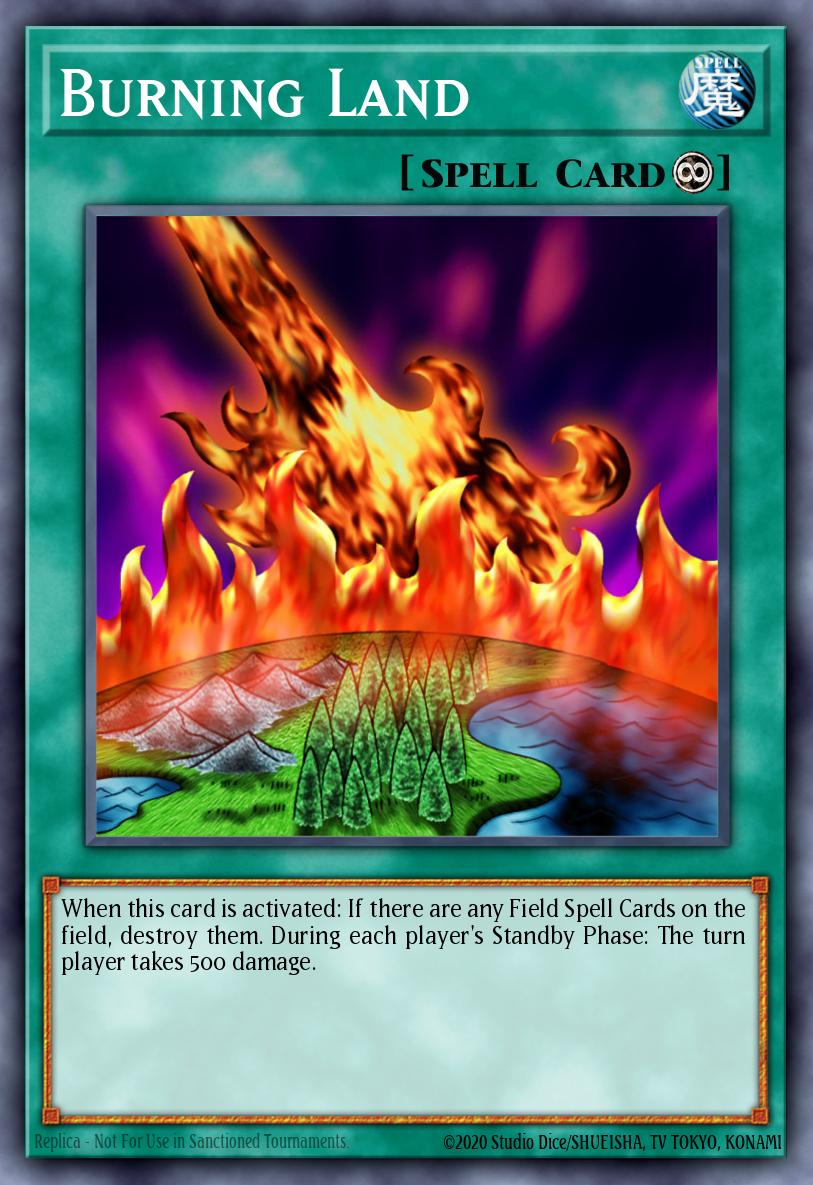
When this card is activated: If there are any Field Spell Cards on the field, destroy them. During each player's Standby Phase: The turn player takes 500 damage.

Burning Land — Power Evaluation
Final Score: 42 ± 8 · Confidence: Medium
- Intrinsic: 44 · Deck: 41 · Meta: provisional
- Primary role: Utility · Secondary: Board breaker
Why it scores here
Burning Land is a Continuous Spell whose only conversion is symmetric damage: 500 to the turn player each Standby Phase, plus destruction of Field Spells when it activates. It has no searcher, no card advantage and no board, so resource economy and combo conversion stay low. The score is held up mainly by its presence in 14 sampled decks across 9 archetypes and its cheap single-slot cost, with effect interaction limited to the niche Field Spell clause. The card's text is clear, but the lack of combo, guide and usage data keeps confidence at Medium.
Axis scores
| Axis | Score | Evidence |
|---|---|---|
| Accessibility | 45 | Live in 14 sampled decks across 9 archetypes, but it is a non-searchable, situational spell with no starter role or searched-for role data (observed/inferred). |
| Combo & Conversion | 20 | No recorded combo boards (total combos 0), and the card does nothing on its own beyond damage (verified from text). |
| Resource Economy | 10 | Pure life-point damage with no draw, search or refuel; the turn player takes 500 per Standby (verified from text). |
| Effect & Interaction | 35 | Destroys Field Spells on activation, a narrow clause; no negation or generic removal (verified from text). |
| Material Utility | 5 | Spell card, cannot be used as material (verified from text). |
| Resilience & Flexibility | 50 | Continuous Spell stays on the field across turns, but any spell or trap destruction removes it (inferred from text). |
| Deck-Building Efficiency | 70 | One slot with no garnet or lock; decks already run it at a 1.71 average (observed), though the DuelLinks copy limit of 1 conflicts with the deck data (observed). |
Calculation
Weight profile: 0.7 Utility + 0.3 Board breaker (blend; Board breaker is the secondary role). Intrinsic ≈ 44, Deck ≈ 41, Meta = provisional. Modifiers: Limited-to-1 (DuelLinks legal copies) (-2). Final formula: 0.40*Intrinsic + 0.60*Deck
Strengths
- Cheap single-slot spell that fits many archetypes (9 distinct).
- Persistent damage clock that stays on the field across turns.
- Answers Field Spells outright when activated.
Weaknesses
- No card advantage or board presence; its only output is life-point damage.
- Damage hits the turn player, so it is a symmetric drawback in many matchups.
- Situational Field Spell destruction and no searcher or combo role.
Counters / choke points
- Removing the Continuous Spell via spell/trap destruction ends the damage clock (inferred from text).
- Field-spell-light decks lose the destruction clause entirely (inferred).
Best use
Utility / Board breaker in Field Spell-heavy matchups. Decks: Greed, D.D., Harpie. Suggested copies: 1.
Evidence & gaps
- Verified: Text: destroys Field Spells on activation; 500 damage to turn player each Standby Phase.; Continuous Spell; cannot be material.; legal copies duellink = 1.
- Observed: Present in 14 sampled decks across 9 archetypes; 57% in gameplay type 4.; Average 1.71 copies per deck, max 3.
- Inferred: Symmetric damage makes it a drawback in most matchups.; Destruction by spell/trap effects removes it.
- Data gaps: no combos supplied; combo conversion is text-only inference no guides supplied no usage statistics (StatisticsCard) available legal copies lists only duellink; TCG/OCG/MasterDuel limits unknown DuelLinks limit of 1 conflicts with deck copies up to 3